
Exploring different leadership styles for effective decision making

What makes a really great leader?
Historically, leadership research focused on examining the leader’s individual characteristics, such as their personality, behaviors, and background, to answer the question of what makes a great leader.
Most of the results say that the great leader possesses a combination of traits, skills, and behaviors that inspire, motivate, and guide others towards a common goal.
But decision-making often keeps every leader awake at night.
I encourage you to read this article, which presents a longer history of leadership research:
How to Choose a Leadership Pattern, Harvard Business Review
Based on the above we can have the following styles:
-
Autonomous Decision-Making: You make the decision independently and announce or sell it to the group. You may gather information from the group or other sources that you find relevant to the problem.
-
Consultative Decision-Making (Individual): You present the problem to the group members individually, gather their suggestions, and then make the decision.
-
Consultative Decision-Making (Group): You present the problem to the group members in a meeting, gather their suggestions, and then make the decision.
-
Facilitative Decision-Making: You present the problem to the group in a meeting and act as a facilitator. You define the problem and set boundaries for the decision-making process. Your objective is to achieve consensus on a decision, without giving undue weight to your own ideas based on your position.
-
Delegative Decision-Making: You allow the group to make the decision within defined limits. The group identifies and diagnoses the problem, generates alternative solutions, and selects one or more solutions.
In addition, another helpful definition set comes from Management 3.0:
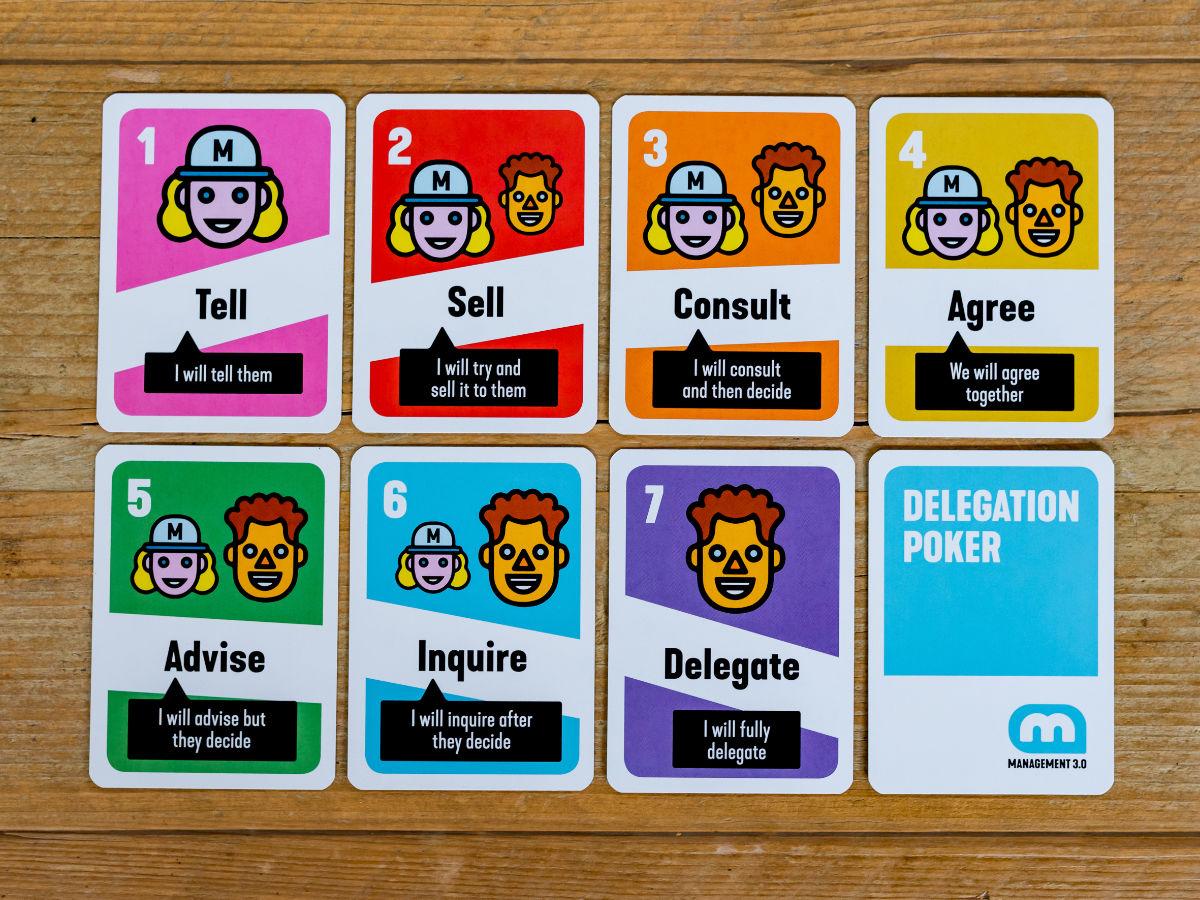
Seven Levels of Delegation
- Tell: You will inform them. You will make the decision based on what you believe is most appropriate, and once it’s made, You will communicate it to them.
- Sell: You will present it to them. After making the decision, You will explain it to them, providing reasons why you believe it’s the best option.
- Consult: You will seek input and then decide. You will gather opinions from others before making the decision, but ultimately, You will make the final call.
- Agree: We will collectively reach a decision. The decision will be made together.
- Advise: You will offer guidance, but they will decide. You can provide suggestions and criteria to consider, but the final decision rests with the collaborator.
- Inquire: You will ask for updates after the decision is made. You won’t express preferences, but You will seek information about the outcome and the criteria used to make the decision.
- Delegate: You will fully entrust the decision. This is the highest level of delegation, where You won’t even need to know the details. You trust others to handle the decision-making process, relieving yourself of the responsibility.
As you can see,
it closely resembles the definition mentioned at the beginning of the post (the one from Harvard Business School).
In general, one of the most challenging tasks of a leader is decision making. Often, we delegate too late, thinking that we can do it ourselves. However, this is usually a biggest mistake (I started delegating too late) that prevents us from developing ourselves, developing others, and developing the entire company.
Thank you, and I wish you success in future decision making,
Łukasz.
// Photo by Ian Schneider on Unsplash