
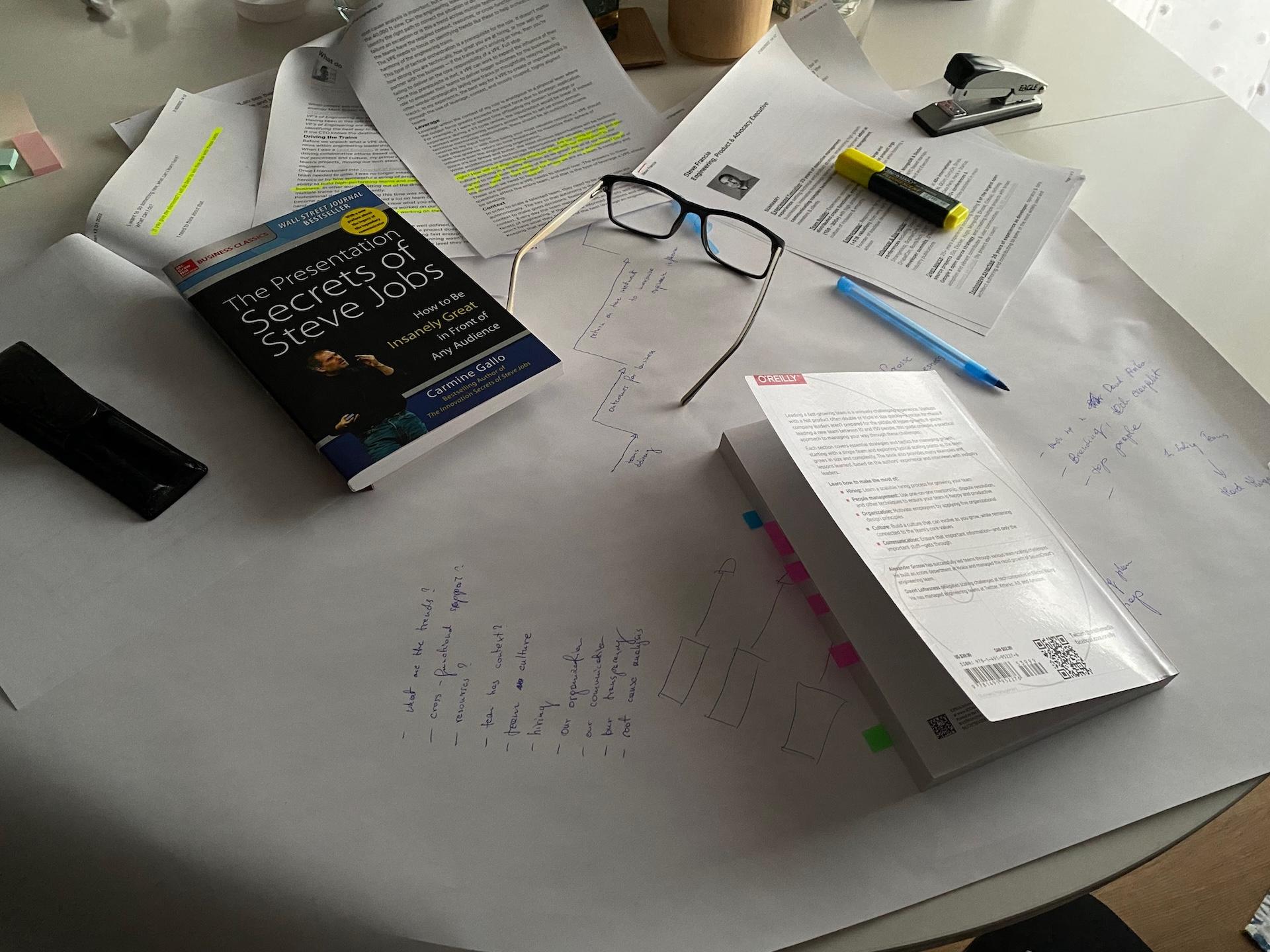
Where the reading, the scribbling and the thinking actually happen.
Software essentials, books, favorite gadgets, and my top recommendations
I'm passionate about books. While tools alone can't fix everything, the quest for the perfect ones can eat up a lot of your time. Below is a comprehensive list of all my top choices.
Bibliography
People
The 7 Habits of Highly Effective People. Stephen R. Covey
Joel Spolsky’s Concise Guide to Finding the Best Technical. Avram Joel Spolsky
Start With Why. Simon Sinek
Atomic Habits. James Clear
The Presentation Secrets of Steve Jobs. Gallo, Carmine
Thinking in Systems. Donella MeadowsStrategy
Good Strategy Bad Strategy: The Difference and Why It Matters. Richard Rumelt
Blue Ocean Strategy. W. Chan Kim, Renée Mauborgne
Measure What Matters. John Doerr
Life After Google: The Fall of Big Data and the Rise of the Blockchain Economy Gilder, George
The Future Is Faster Than You Think. Peter H. Diamandis, Steven Kotler
A Data-Driven Company: 21 lessons for large organizations to create value from AI. Richard Benjamins
The year in tech 2023. Harvard Business review
Competitive Strategy: Techniques for Analyzing Industries and Competitors. Michael E. PorterManagement
High Output Management. Andrew S. Grove
The Hard Thing About Hard Things. Ben Horowitz
Winning: The Ultimate Business How-to Book. Jack Welch, Suzy Welch
The Practice of Management. Drucker Peter F.
Managing Humans. Michael Lopp
Technical leadership. Od eksperta do lidera. Mariusz Sieraczkiewicz
It Doesn’t Have to Be Crazy at Work. David Heinemeier Hansson, Jason Fried
Team Topologies. Skelton, Matthew
Effective Remote Work. Stanier, James
One Minute Manager. Ken Blanchard
Evidence-Based Management Guide. Scrum.orgAgile
Clean Agile: Back to Basics. Robert Martin
Agile Leadership Toolkit: Learning to Thrive with Self-Managing Teams. Koning Peter SCRUM i nie tylko. Krystian Kaczor
Scrum. O zwinnym zarządzaniu projektami. Mariusz Chrapko
Agile Retrospectives: Making Good Teams Great. Esther Derby, Diana Larsen, Ken SchwaberDevOps
The DevOps Handbook. Gene Kim, Jez Humble
The Phoenix Project: A Novel about IT, DevOps, and Helping Your Business Win Hardcover. Gene Kim, Kevin Behr, George Spafford
Accelerate: The Science of Lean Software and DevOps: Building and Scaling High Performing Technology Organizations Paperback. Nicole Forsgren PhD, Jez Humble Gene Kim
Powerful Command-Line Applications in Go Build Fast and Maintainable Tools. Ricardo Gerardi
Go for DevOps. John Doak, David Justice
Hands-On System Programming with Linux: Explore Linux system programming interfaces, theory, and practice. Kaiwan Billimoria
eBPF programming with Rust. Vishal PatilSoftware Engineering
Patterns of Enterprise Application Architecture. Fowler Martin
Apprenticeship Patterns: Guidance for the Aspiring Software Craftsman. Dave Hoover, Adewale Oshineye
Clean Code: A Handbook of Agile Software Craftsmanship. Martin Robert
Clean Architecture: A Craftsman’s Guide to Software Structure and Design. Martin Robert
The Pragmatic Programmer. David Thomas, Andrew Hunt
Extreme Programming Explained. Kent Beck
TDD. Kent Beck
Code Complete. Steve McConnell
The Way of the Web Tester: A Beginner’s Guide to Automating Tests. Jonathan RasmussonData Engineering
Designing Data-Intensive Applications: The Big Ideas Behind Reliable, Scalable, and Maintainable Systems. Martin Kleppmann
Fundamentals of Data Engineering: Plan and Build Robust Data Systems. Joe Reis , Matt Housley
Kafka: The Definitive Guide: Real-Time Data and Stream Processing at Scale. Gwen Shapira, Todd Palino, Rajini Sivaram, Krit Petty
Data in Digital Advertising: Understand the Data Landscape and Design a Winning Strategy. Kosorin, Dominik
Deep Learning. Ian Goodfellow, Yoshua Bengio, Aaron CourvilleStartup
The Innovator’s Dilemma: When New Technologies Cause Great Firms to Fail. Christensen, Clayton M.
Competing with Unicorns: How the World’s Best Companies Ship Software and Work Differently. Jonathan Rasmusson
The Lean Startup. Eric Ries
Anything You Want. Derek Sivers
Creativity Inc: Overcoming the Unseen Forces That Stand in the Way of True Inspiration. Ed Catmull
Masters Of Doom: How two guys created an empire and transformed pop culture. David Kushner
The Inventions, Researches and Writings of Nikola Tesla. Nikola Tesla
Entreprenerd: Building a Multi-Million-Dollar Business with Open Source Software. Bruno Lowagie.
Nagrastory. Stefan Kudelski
Startup Boards. A field guide to building and leading an effective board of directors. Brad Feld, Matt Blumberg, Mahendra RamsinghaniInvesting
Economics in One Lesson: The Shortest and Surest Way to Understand Basic Economics. Henry Hazlitt
The Intelligent Investor. Benjamin Graham
Common Stocks and Uncommon Profits. Philip A. Fisher, Kenneth L. Fisher
Wskaźniki ekonomiczne. Przewodnik dla inwestora. Richard Yamarone
Inwestycje. Instrumenty finansowe. Krzysztof Jajuga, Teresa Jajuga
Kryzysy gospodarcze a wiarygodność sprawozdań finansowych.
Kutera Małgorzata, Surdykowska Stanisława T.
Warren Buffett and the Interpretation of Financial Statements. David Clark, Mary Buffett
Secrets of Sand Hill Road: Venture Capital and How to Get It. Scott Kupor
Anioł w piekle. Lech Kaniuk
The Man Who Solved the Market: How Jim Simons Launched the Quant Revolution. Gregory Zuckerman
Diary of a Very Bad Year: Confessions of an Anonymous Hedge Fund Manager. Anonymous Hedge Fund ManagerList Order
The order, in a certain sense, matters; I try to arrange the books in a way that from the top, they have the most impact and significance.
Workstation
14” MacBook Pro, M2 Pro, 32GB RAM (2023)
I've been using Macs since 2013, and my current tool of choice is the 14” MacBook Pro with an M2 Pro chip. Its exceptional performance and reliability make it indispensable to my workflow, managing tasks from coding to content creation.
GPU Stations, GeForce RTX 4070 to RTX 5070
I remotely utilize my Mac for executing machine learning tasks and other computationally intensive calculations on these stations, which range from a GeForce RTX 4070 to a GeForce RTX 5070 and run Ubuntu. They are complemented by 64GB to 96GB of RAM. This setup not only provides the robust processing power needed for my most demanding projects but also supports CUDA, enhancing the performance of deep learning and other GPU-accelerated applications.
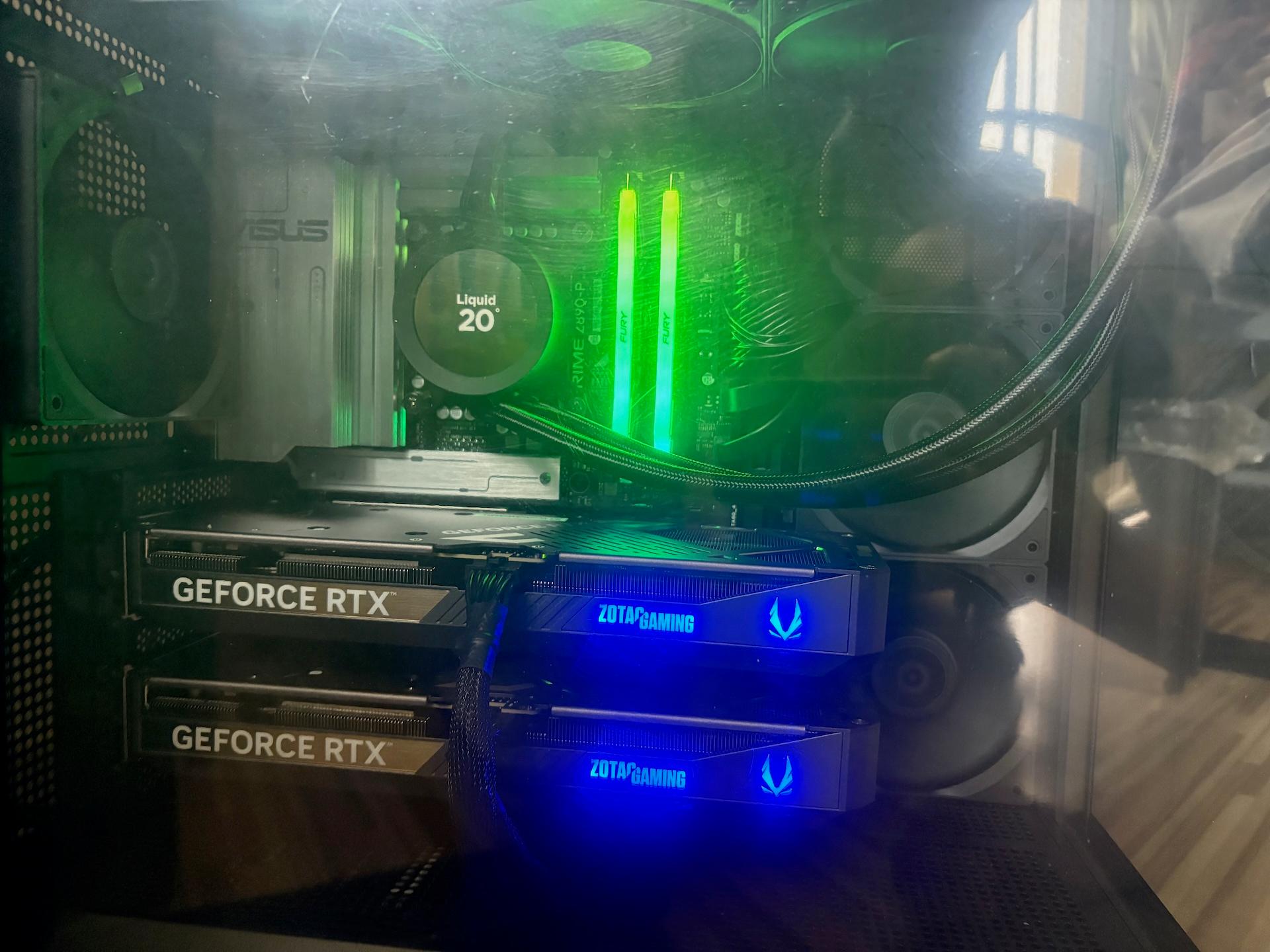
One of the latest workstations added to the pool Display Eizo FlexScan EV2785-WT
I have a deep appreciation for the Eizo brand, known for its exceptional quality and reliability. My setup includes three 27-inch displays connected to my Mac. One standout feature is the ability to charge my Mac through a single cable while connected to these displays, streamlining my workspace and reducing cable clutter for a more efficient and productive environment.
Keychron K8 Pro Mechanical Keyboard
I love mechanical keyboards, and the Keychron K8 Pro Mechanical Keyboard meets my needs. Its distinctive sound remind me of my very first mechanical keyboard, evoking a sense of nostalgia.
Insta360 4K Camera
I use the Insta360 4K Camera for remote calls to maintain a professional appearance. Additionally, the camera's gesture control and following features make it incredibly user-friendly, adapting to my movements for a more dynamic and engaging presentation.
Elgato Key Light Air and Stream deck mini
I utilize the Elgato Key Light Air and Stream Deck Mini for my remote calls, where they prove to be solid tools. The Stream Deck Mini allows me to quickly mute, share, and enable my camera with the press of a button. The Key Light Air ensures that I am professionally lit. Together, they enhance the quality and efficiency of my remote communication.
Herman Miller Embody Chair
I use the Embody Chair from Herman Miller, which meets my needs, including an additional headrest supporting the head. Its ergonomic design, an ideal choice for long hours of work.
Development tools
JetBrains Toolbox
I highly appreciate JetBrains and the convenience their Toolbox offers. It simplifies managing different IDEs like PyCharm, WebStorm, and CLion, making it incredibly easy to switch between environments tailored for specific development tasks.
Docker
I prefer not to install software directly on my Mac, and Docker meets this preference perfectly. Its providing both the cleanliness of keeping my system uncluttered and the portability to easily move and manage applications across different environments.
AWS Cloud Development Kit
Recently, I’ve started really liking the AWS Cloud Development Kit (CDK). It’s cool because it lets me use Python. What's great about the AWS CDK is how quick and easy it makes building MVP (Minimum Viable Product) projects.
Design
Excalidraw
I use Excalidraw for its intuitive and straightforward approach to diagramming and sketching ideas. Its simplicity allows me to quickly visualize concepts and workflows in a manner that feels as natural as drawing on paper.
Productivity
Mac notes / Notion
I utilize both Mac Notes and Notion for organizing my thoughts, projects, and daily tasks. Mac Notes offers quick and seamless integration with my macOS ecosystem. Notion, on the other hand, provides a more comprehensive platform for detailed documentation.
Google Sheets and Slides
I use both Google Sheets and Google Slides for project management and presentations, respectively. Together, these tools form a dynamic duo that supports the efficient management and effective presentation of projects.
Jira Software
Jira Software’s new Timeline and Plans features really hit the spot. The Timeline lets you see how all the tasks stack up and intersect at a glance, making planning a breeze (could planning be any easier?). Plans help with sorting out who’s doing what and when. These features have made managing projects way smoother and more straightforward—just like Chandler (Friends) trying to be smooth, but in this case, actually succeeding.